What was a Roman Dodecahedron used for?

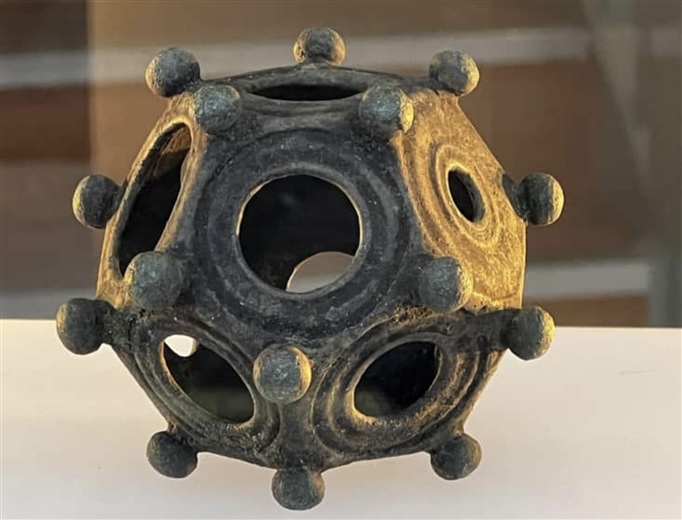
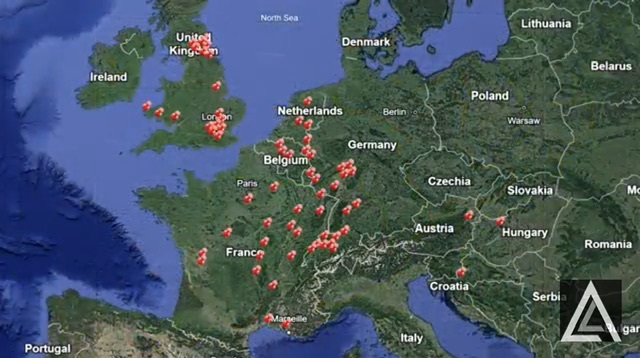
Roman dodecahedra have been found in Britain, much of Europe, but not Italy. The context of use is uncertain, but some have been found in areas of military or funerary activity. Others have been discovered in coin hoards, suggesting they were objects of value. Some dodecahedra were found in baths, one was found in a theatre, another on a river bed.

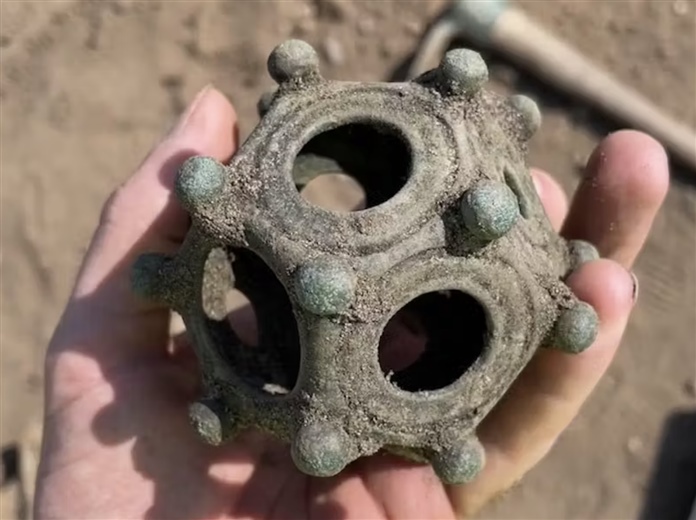
Dodecahedra are usually cast in copper alloy, of varying design, size between around 4cm to 11cm diameter. The holes on each face are of different sizes and decoration varies with circles, lines and dots being common.

To date, the purpose of these objects has eluded archaeologists, but suggestions have included: Measuring device, knitting tool, metal worker practice piece, or less seriously, spaghetti measure.

What did the Romans call these dodecahedra?

How did the Romans use them?

There are no incorrect answers, as yet!
        
Norton Disney Archaeology Group

https://theconversation.com/beautifully-crafted-roman-dodecahedron-discovered-in-lincoln-but-what-were-they-for-229131

https://en.wikipedia.org/wiki/Roman_dodecahedron

Parents
  • So if they haven’t been found in Italy, from the map, it looks like an army on the move, no paintings or drawings exist showing it as being used for sport or leisure. The small hole lining up with a larger one could be used for measuring distance. I’ve stolen this map from the internet.

  • That map illustrates your theory well. 

    You have made me wonder if the object was used in school geometry classes.

  • If for school then why none in Italy? It has to be something you would need when travelling long distances.
    Looking at the map, some of the finds are practically in straight lines, obviously the Romans were known to travel in straight lines.
    I would think quite high status as they aren’t found in great quantities. If for everyday use, it would be easier and cheaper to carve out of wood.  Rome was founded on The twelve tables of law, also there were twelve main gods and goddesses. ( twelve sides) The calendar didn’t become twelve months until much later. Another possibility is that it was to gauge the size of something for payment.

Reply
  • If for school then why none in Italy? It has to be something you would need when travelling long distances.
    Looking at the map, some of the finds are practically in straight lines, obviously the Romans were known to travel in straight lines.
    I would think quite high status as they aren’t found in great quantities. If for everyday use, it would be easier and cheaper to carve out of wood.  Rome was founded on The twelve tables of law, also there were twelve main gods and goddesses. ( twelve sides) The calendar didn’t become twelve months until much later. Another possibility is that it was to gauge the size of something for payment.

Children
  • Let us know how you get on with the replica. Would be cool to see if you decide to make it.

  • I was thinking about the weight, the larger ones would have been quite heavy. I’ve used bronze, it is really heavy. It’s all relit an old interest, I’m thinking of making one out of steel and then polishing it. Ball bearings brazed on would be ideal for the knobles.

  • Yes, the Germans did pillage Rome. It would be great if one was found in Pompeii, it would still be in situ. Unfortunately it was destroyed in 79AD, a bit too early.
    I thought about different size candles to measure time, some were found with wax remains, objects do tend to get repurposed over time though. A lot of finds around  Londinium  but nothing near Aqvae Svlis ( Bath).

  • I was sitting there thinking about it last night, I went down a similar rabbit hole of the number 12 being of significance. 12 months, 12 is a religious number for some, 12 major roman gods; Jupiter, Saturn etc. I also figured its light weight means it’s easily carried and fits in the palm of a hand. 

  • Could the lack of finds in Italy be explained by most of the dodecahedra being of the 2nd to 4th century? The fragmentation of Roman society and cultural shifts in remaining populations may have lead to civil wars, but it is likely there was some cooperation between the Romans and members of preexisting populations in the mid/north western parts of Europe, and perhaps the dodecahedra evolved in this context? 

    I think the object would be handy to gauge something for payment. The holes could be temporarily blocked, perhaps leaving the appropriately sized hole open. 

    I am hoping that one day, someone will discover a fresco illustrating the the illusive context, or someone might have referred to the dodecahedron when writing instructions on a tablet.