
RESEARCH INVITATION: Looking for autistic people who experience obsessive compulsive disorder (OCD) symptoms!

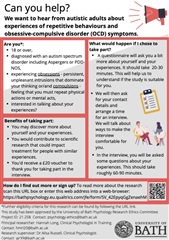
Hi! My name is Hannah Long and I am a Trainee Clinical Psychologist at the University of Bath. I am interested in how autistic people experience OCD symptoms alongside repetitive behaviours related to autism.

Why?

Research trying to understand the differences between OCD and repetitive behaviours has primarily used questionnaires and structured clinical evaluations. There has been less research asking autistic people who experience OCD about how they understand and differentiate between OCD symptoms and autism-related repetitive behaviours. This study aims to learn more about the personal experience of both autism and OCD symptoms.

 What will I be asked to do?

The first part of this study is an online survey. The survey asks questions to check whether this study is appropriate for you, asks demographic questions, and questions about OCD symptoms. In the second part of the study, you will be interviewed over Microsoft Teams or in person (depending on preference) about your experiences of autism-related repetitive behaviours and OCD symptoms.

To take part in this study you must: 

  • Have a clinical diagnosis of Autism Spectrum Disorder (including Asperger’s syndrome, Autism, Pervasive Developmental Disorder) given by a medical health professional and be able to show a report or letter detailing this to the researcher.
  • Experience OCD symptoms (no diagnosis required).
  • Be 18 years or older.
  • NOT have a diagnosis of an intellectual disability. 
  • NOT have a diagnosis of an enduring mental health problem which has significantly affected you throughout your life, not including OCD. For example, personality disorder, schizophrenia or bipolar affective disorder.
  • NOT require an interpreter to complete the interview phase of this study. Please note all interviews will be conducted in English.

How long does it take? 

The online survey will take 20-30 minutes. The interview will take 60-90 minutes. Participants who complete both the survey and interview will receive a £20 voucher as a thank you for their time. Participants who only complete the survey will not receive a voucher.

I'd like to take part, what do I do next? 

To take part, please follow this link to the survey: https://bathpsychology.eu.qualtrics.com/jfe/form/SV_42EpyqGgZenaehM ; or you can scan the QR code on the attached flier. 

If you have any questions about this study, please contact me by email: Hannah Long (hmrl20@bath.ac.uk). Please note that this study will be recruiting participants between 01/05/2022 to 01/10/2023 but may close earlier if sufficient number of people take part. 
Parents
  • Hi Hannah, 

    Just out of curiosity, does this study take into account the intensity of impact Autistic individuals experience? Many Autistics spend their lives troubleshooting practical, external issues when known so that they are not experiencing pain. Lights, sounds - frequency and dB, chemically made scents or VOCs, tar-based fibres, and many other sensory related items which might be read on a hard instrument (spectrometer for instance) can be intensely felt by us. anothers unknown emotions, the psychology in exchanges, the mysterious systems of communication, from politics to power - we sense it ALL. If we're still dealing with language issues, or if it's an overload in the brain, it's compounding the issue of not identifying what's Actually Happening coupled with Actually sensing it. We feel barometric pressure, have keen senses for navigation, can tell time with birdsong. 

    If your questions involve the simple - "Do you know why you do X" with room for us to fill that in, it will help with accuracy. OCD for autistics is not a disordering - but finding practical applied ways of dealing with the world so our raw senses can be shielded from possibly getting waterboarded by it. We don't sublimate the way Neurotypical individuals do. So we're not repressing desire and "transmuting" that into mature behaviour (as Jung would word). OCD for a Non-Autistic in this sense would be a way of dealing with guilt or wanting to control a thing which isn't mine to control. However, for the Autist, once I have turned my home in to a sanctuary what appears as OCD is actually called Diligence, Responsibility. I have a set of things to take daily for health. I have applied disciplines which help keep me focused daily. Due to a more hyper-active brain, if I don't engage purposeful focus I might be a safety hazard. 

Reply
  • Hi Hannah, 

    Just out of curiosity, does this study take into account the intensity of impact Autistic individuals experience? Many Autistics spend their lives troubleshooting practical, external issues when known so that they are not experiencing pain. Lights, sounds - frequency and dB, chemically made scents or VOCs, tar-based fibres, and many other sensory related items which might be read on a hard instrument (spectrometer for instance) can be intensely felt by us. anothers unknown emotions, the psychology in exchanges, the mysterious systems of communication, from politics to power - we sense it ALL. If we're still dealing with language issues, or if it's an overload in the brain, it's compounding the issue of not identifying what's Actually Happening coupled with Actually sensing it. We feel barometric pressure, have keen senses for navigation, can tell time with birdsong. 

    If your questions involve the simple - "Do you know why you do X" with room for us to fill that in, it will help with accuracy. OCD for autistics is not a disordering - but finding practical applied ways of dealing with the world so our raw senses can be shielded from possibly getting waterboarded by it. We don't sublimate the way Neurotypical individuals do. So we're not repressing desire and "transmuting" that into mature behaviour (as Jung would word). OCD for a Non-Autistic in this sense would be a way of dealing with guilt or wanting to control a thing which isn't mine to control. However, for the Autist, once I have turned my home in to a sanctuary what appears as OCD is actually called Diligence, Responsibility. I have a set of things to take daily for health. I have applied disciplines which help keep me focused daily. Due to a more hyper-active brain, if I don't engage purposeful focus I might be a safety hazard. 

Children
No Data