


you're correct Lem is to my liking
wow you copied his name written using polish letters, there is ''ł'' inside, it's pronunced like english ''w'', while polish ''w'' is pronunced like english ''v'', now try to imagine it pronunced correctly 
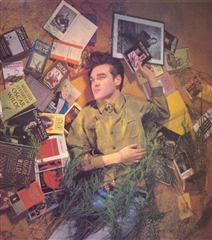
The Picture of Dorian Gray - Oscar Wilde
Sexual Personae: Art and Decadence from Nefertiti to Emily Dickinson - Camille Paglia
The Occult - Colin Wilson
The Perfect Prince: The Mystery of Perkin Warbeck and His Quest for the Throne of England - Ann Wroe
The Woman in Black - Susan Hill
Ways of Seeing - John Berger
The Origin of Consciousness in the Breakdown of the Bicameral Mind - Julian Jaynes
The Passion of Michel Foucault - James Miller
Affinity - Sarah Waters
Ghost Story - Peter Straub
The bible - central to my faith
Getting Started in Electronics - started me thinking about the world and how it worked as something to be manipulated technically (https://mightyohm.com/blog/2008/12/the-greatest-electronics-book-ever-written/)
the usborn book of computing. - introduced me to programming
groups and symmetry’s - around reading this book I thought university might actually be a good idea. (https://shop.elsevier.com/books/groups-modular-mathematics-series/jordan/978-0-08-057165-2)
the grolier multimedia encyclopaedia - taught me so much about the world beyond my bubble.
I suspect there would be far too many to answer if I really thought about this, but here are a few:
Rudyard Kipling is beyond cancelled these days, but as a young child, The Just So Stories was probably the first book I liked for the style in which it was told as much as the stories themselves.
My favourite authors, Franz Kafka, Jorge Luis Borges and Philip K. *** have doubtless influenced my worldview in numerous subtle and unsubtle ways.
Probably lots of bits of poetry have lodged in my head and underscored moments of my life.
Non-fiction: The Righteous Mind Jonathan Haidt springs to mind as something that influenced me fairly recently. The essays of George Orwell have been a big influence on how I see the political world, even though I am absolutely not a socialist.
Also a number of twentieth century Jewish Jewish texts that largely revolve around the idea of being a fully-observant Orthodox Jew, but also having an existentially-aware and authentic inner life. Details available on request, but I think it probably departs from the interest of most people here.
"[His] library was a fine dark place bricked with books, so anything could happen there and always did. All you had to do was pull a book from the shelf and open it and suddenly the darkness was not so dark anymore."
Ray Bradbury
At 14 I took every opportunity to sit in the school library and read the Roman Britain book, I should really get myself a copy for nostalgia's sake. I have their successors, Salway and Stenton, (separate volumes) but their prose is not nearly as good at painting pictures in my mind.
That’s so cool that such an early book influenced your career choice. I’ve just realised that books in general influenced mine. Or rather, the feel of libraries. Heavenly zones of quiet, ordered universes on every shelf. More potent than a church for that most rarified of atmospheres: a sacred hush in the presence of something simultaneously modest and transcendent.
Seeing you quote me there realised I’m over complicating it with the mind of and adult. I just found a PDF of Dogger online and really it’s power is very simple: it’s about kindness. And accidental hurt. But mostly kindness.
‘And then Bella did something *very* kind…’ I’m 45 years old and I’m in tears at just that sentence.
I love that final thing at the end too. ‘Won’t you miss that big teddy?’ ‘Not really’ said Bella, ‘he was too big and his eyes were too stare-y’ I think she might be playing it down, it’s ambiguous. But it’s more important to her that her brother wasn’t sad anymore. I’m not sure any adult book has taught me anything more profound than that, not so purely and concisely anyway. It’s like magic.
'The Children's Animal World Encyclopedia', published by Paul Hamlyn in the late 1960s was certainly one of the reasons I eventually did a zoology degree and went on to a career in biological research.
'Roman Britain and the Anglo-Saxon Settlements', by Collingwood and Myres. Dry as dust to some, but it turned me on to history and archaeology.
'Stormbringer' by Michael Moorcock, opened up the worlds of Fantasy and Sci-Fi to me.
Most importantly, 'Treasure Island', by Robert Louis Stevenson. It made me a voracious reader, of everything, but especially fiction. It also made me convert one of my mother's largest knitting needles into a cutlass. Arrr!
those poems like stories remind me of Julian Tuwim poems I loved as a kid, especially ''Glasses'' and ''Locomotive'', poems were written in polish almost a century ago, but I found a website with most of them wierszykidladzieci.pl/wierszetuwima.php , and if you right click somewhere blank with page open and choose 'translate to english' google does decent translations these days, but it makes mistakes still.
If there’s a common theme there, it’s about lost causes and the wish fulfilment,
For me it was adventure/exploration. I was locked in my room most of my childhood between 7 and 15 y.o. except going to school and back.
Apparently I was reading from very early on. Thinking about my earliest days first then… I remember a couple of books that were my earliest memories of getting choked up at a story rather than ‘merely’ diverted or amused. I got them out of the library repeatedly. The first one was called The Man Who Took His Indoors Out, a lovely illustrated book written in verse. It was about this bloke who got felt sorry for the somewhat sentient furniture and utensils imprisoned in his house. So one day he takes them out for a walk - the piano, sofa, all the plates and cutlery, the grandfather clock - the lot. They’re absolutely loving it, but start to get unruly in some ways, and it gets out of his control. Before he knows it, as it’s starting to get dark, the furniture races ahead leaving him alone and it goes to the beach, some of it jumping in the sea. Wild abandon basically. He’s trying to catch up with them for days saying ‘please come back’ and then gets too tired and sad and goes home. All he has left is his old rocking chair and he goes into a deep sadness sitting in it. A year passes, and every day he watches from the uppermost window hoping to see even one thing return. One snowy winters day, he hears the distant sound of piano keys. And one by one, all his exhausted furniture stumbles back up the lave and into his house every bit of it is chippped or scratched or knocked out of tune or cracked. But he’s just so happy to see them he says ‘honestly, it’s fine guys- I’m just delighted you’re here at all’ (or similar), come in from the cold. And then because he’s so happy he dances with the rocking chair out on the porch like a carefree lunatic. I’m not sure what it was that moved me so deeply - it’s quite a silly story. I think it was the fact that he just forgave the entire thing because he loved his belongings unconditionally and the fact that they were all fucked up now didn’t matter to him, they were back and safe and that’s all that’s mattered.
The other one that hit me like that was Dogger by Shirley Hughes about a wee boy who loves his toy dog (a soft toy that’s seen better days) but it accidentally gets sold in a jumble sake and he’s inconsolable. But then his sister helps him get him back by giving away to the girl who bought him the big teddy bear she won at the jumble sale, as a swap. She gave up her big prize to make her wee brother happy again. The selflessness of that still makes me want to cry. it’s so gorgeously illustrated too.
If there’s a common theme there, it’s about lost causes and the wish fulfilment, the fantasy (I now see as an adult) that they’re never truly lost. That the people and things we love but who are lost to us… might one day come ‘home’. It’s a nice story to tell ourselves when we need the tiniest bit of hope.
Quo vadis?
It's impossible to answer Simon, I swallowed to many to early. I discovered public library when I was 10. By accident.
Nowadays whenever I think about all the books I read I only see a deep well, with walls covered with books, and an 'unknown' pile in a middle at the bottom, slowly sinking down. A lot of what I read early is in that pile, resurfacing a page sometimes. I had a 'glimpse' of my current indexing system, when I was 15, struggling to keep up with making notes during classes, and I started developing shortcuts.
I don't know if I'm crazy. My mom forgot to test me. It's paraphrasing Sheldon Cooper's saying ''I'm not crazy. My mom had me tested''. LOL
Going back to when I was little, the most important book in my life was called The Magic Paintbrush by Fran Hunia. I would read it everyday. It was the story of a child who had a paintbrush that could bring to reality anything he painted with it. An evil emperor captured him and made him paint material objects for his own greed and at the expense of others around him The boy rejected this notion and escaped and went on to help people with its powers. A very condensed and simplified summary that doesn’t quite do it justice, but enough to set the scene. I think even at that young age I was on the peripheries and spent a lot of time alone and in my imagination. I used to think of all the good that I could do with that paintbrush. It was a very comforting story. And it helped teach me that not everyone saw the world the way I did. Unfortunately there are people who take whatever they can at the expense of others. This story taught me caution, but also let me imagine and live in fantasy for a little while each day. I was young at the time, it is a children’s book. I have recently, after a lot of searching, found and bought a copy and plan on reading to my daughter when she is old enough.


