what kind of work do people do?

I'm quite curious what kind of work do people here do? I've seen from some comments in other threads that there are social workers and teachers out there. The stereotypical autism job is computer programmer, which I think is really cool and requires lots of talent. There are also students on this forum (I'd be interested to know what you're studying). 

Also, what jobs do you think are well-suited for the autistic personality?

  • It might help in the future but my position is now one of trying to support the next generation in my family, bearing in mind that formal paid work might not be possible, although i hate to say that and wouldn't want to make any assumptions.  

    In my 1:1s with a support worker, they were talking about accomodations such as noice cancelling headphones or sitting in a corner of an office.  And all the time i'm thinking, yes, the easy stuff.  And no this wouldn't have helped.  What I'd actually need to do is cancel out some trends that I think make working life difficult, such as strip lighting, fans buzzing, noisy open-plan offices, hot desking, constant phones ringing and other interruptions and basically all the factors that generally go in to office life.  And to do this I think the main hope would be to go self employed and have a home office because it probably wouldn't be seen as reasonable or affordable to most employers.  Plus I  feel as though I'm actually allergic to corporate life, although I clearly won't be getting a doctor's note to that effect any time soon. 

    Now, with all the skills I've gathered over thepast decades, i could probably exert more control and work for myself.  But as for the next generation starting out (and maybe quaking in their shoes at the prospect, like I was at that age) i'm not sure how it might look.  if someone's almost paralysed at the thought of speaking to someone and feels threatened by basically leavig the house, it seems unlikely that they'll set up their own business or fit easily into one that's already there.  :(   

  • Yes, I think one of my issues is that I've somehow always been an outlier, on the tail of the bellcurve.  And one issue that's kept coming back has been others' disbelief or disregard of my difficulties.  Something along the lines of, "But you're so intelligent so surely you can... " or "But that's just silly" or "That's the job.  Take it or leave it."  And throughout this time I never had a diagnosis so I just kept redoubling my efforts and driving myself further and further towards breakdown.  

    It all feels full of potential conflict to me because I was always lumped with the majority of cases when actually something else was going on.   Something else called autism.   I can see now that many of my difficulties related to this and also that, if I'd had a diagnosis, some of my former employers would have fallen foul of legislation on disability and discrimination.   However, although i suffered significant losses and psychological harm through all of this (and knew that this was happening even when I couldn't give it a name) there's no case against anyone and no compensation due to lack of knowledge on both sides. 

    So this is what I'd now fear from any official body working on a case by case basis.  Lack of knowledge and awareness leading to predictable results.  :(  

    now unfortunately it seems to me that the DWP is commissioned to shake out individual cases as far as practicable.  So the weight of evidence for any claims is deliberately placed quite high.  And reviewed quite often.  This puts us on the back foot and in the position of seeking corroboration from employers and the health system.  So the level of accommodation and understanding might depend upon the interplay between these three bodies - NHS, employers, DWP.   i don't think I really trust this process so I'd probably begin here to redesign things.  For a start it'd all have to come from a very different core assumption - not one of disbelief with a huge burden of proof placed on the individual, but a system in which officialdom works seamlessly to understand, support and find accommodations wherever possible.  

    i might be dreaming again though... 

  • 'If you try hard enough and work hard enough, you will succeed' certainly hasn't applied for me.

    When I do a bit of cognitive therapy on myself, this often turns out to be the hot thought at the centre of my distress.  It's so ingrained and was repeated so often in education.  Hard work equates to positive results.  :(  This is the one that needs defusing in my mind because it leads to so much "this for that" thinking - i.e.  thoughts along the lines of "If I do this, i get that."    

    But so many other factors bear down upon us.  We might have a sense of agency, but this only takes us so far.  The true picture would take in a host of influences, including other individuals, yes, but also their/our collective effects (the economy, the culture, the government etc), and also other external influences (geography, weather patterns, "acts of God"). 

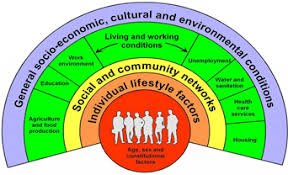
    When I first saw Dahlgren and Whitehead's model this made absolute sense to me.  I don't absolve myself of responsibility, I still do what I can, but clearly I'm just one individual amidst a whole range of pressures and influences that are simply beyond my immediate control.


    And looking at the model now, I think details could be added that relate to each indvidual and probably also to autism.

     To me this is all a huge call to compassion.  Not that the DWP are at all likely to take this into account.    

  • I think I know how you feel. You indeed have potential, Tinyexplorer. I think everyone does. We just need to find the key to unlock it. 

  • Alberta needs firewatch and firefighters. North Alberta is pretty remote, lots of nature, arboreal forest I think you call it, and has natural wildfires. Personally I would miss local shops and would hate the long winter deep freeze! 

  • Unfortunately I don’t really have much academic knowledge of ASD. In terms of Psychology we studied a little bit about the link between Autism and Theory of mind in the 2nd year Social Psychology module. Psychology as a discipline is actually a very broad area and the undergraduate modules tend to cover quite general topics which form the foundation stones of knowledge for the more specific topics. I think Autism would be more suited to a PhD theses than to undergraduate study due to the high level of underpinning knowledge that would be required to ‘fully’ understand all the differences in brain function, thinking and behaviour. In terms of Nursing, Autism actually falls under Learning Disability Nursing and not Mental Health, so I’m not trained in the management of ASD. I do however have experience of working with Autistic children through my voluntary work in Scouting. It is possible to do a part time postgraduate course, over 8 years! I might just wait and do it when the children are adults though!

  • I can't talk about this. Just can't. I want to work, I think I have a lot to offer, a lot of skills, honestly. But I can't bring myself to even think about it. I don't know how to move on.

  • Sorry, it's my fault too for the misunderstanding. I made the assumption too quickly it was doctor who, and I also read too fast and picked up "doctor who" from the sentence "...with the doctor who comes...". Thank you for taking the time and patience to explain that it's a different doctor. I agree, it is really funny that two ASD/AS people are trying to communicate with and understand each other, haha. 

    Just curious, what is the TV show you are talking about?

  • I definitely agree staying in the workplace can continuously be stressful and difficult to maintain after getting ones foot in the door. It's good that you have your diagnosis now. It was unfortunate that you were not able to get support in the 80s, but now with your diagnosis, there's always hope in the future. I have similar experiences of not being able to get help because of a late diagnosis. I can only hope the future will be a bit better now (but of course it's hard to say).

  • This is so funny qwerty, two ASD or AS trying to understand, thank you for pointing out inadvertently that I could have been clearer in my communication, this is something I always complain about with non ASD people, so, the doctor isn't the 'doctor who' character from the dr who series. The doctor is a medical practitioner who goes to see the park ranger. It's a different tv series. I understand that Dr Who is apparently popular with a few people on here so it would be easy to make that link, personally, can't stand the series but did like it when it was Tom Baker decades ago.

  • Ambitions are not always realised and the thing what a lot of people say 'If you try hard enough and work hard enough, you will succeed' certainly hasn't applied for me. 

    This is sometimes the reality! I agree to some extent that trying hard can increase your chance of succeeding, but it still don't guarantee that you will succeed even if you tried your hardest and worked three times more than someone else who just had better luck.

    Beautiful song! I love how well it rhymes and the metaphors are used beautifully. Thanks for sharing.

  • It can go both ways - it might mean that I'm not good at understanding jokes, haha. I think it's mainly because I'm not familiar with Doctor Who, I've only seen one episode my entire life, so I didn't know about this reference. I can imagine it would be funny if I knew the TV image! Thanks for explaining Slight smile

  • Hi qwerty, for some reason my reply posted above in one of you other posts...

  • It was meant to be a joke, you can see how bad I am at it. It's also the job a character had from my all time favorite tv show. It's the image I remember most and his conversation with the doctor who comes to treat him to tell him he's suffering from stress. It's a great scene. 

  • I think we all have many things we would have liked to do, but for some reason a lot of us have been prevented from doing them by the actions of others. 

    Ambitions are not always realised and the thing what a lot of people say 'If you try hard enough and work hard enough, you will succeed' certainly hasn't applied for me.  And when I have thought I am on the way to realising my ambitions I have had the rug pulled from under my feet.

    I don't say this because I want sympathy, or because I am bitter about the way my life has turned out.  After all, we all end up in the same place in the end!

    But all this has reminded me of the lyrics to this song by Brian Bedford (You can find the song on You Tube, but I think it is the lyrics that are the strong part.  It is about ambitions being held back by the actions of others, and others trying to lead your life for you and not want to let go:

    What's the Use of Wings?
    (Brian Bedford)
    
     "I could have been a giant" said the bonsai tree
     "But someone bound my roots and held me down."
     "I could have reached the Heavens" said the snowy owl
     "But they clipped my wings and kept me on the ground."
    
     "I think I heard them tell me that they loved me
     That they'd cared for me--without them I would die
     But what's the use of roots if you can't spread them?
     What's the use of wings if you can't fly?"
    
     "I could have been a singer" said the Myna bird
     "But they caged me and told me what to say."
     "I could have run forever" said the pony
     "But they bridled me and made me go their way."
    
     "I think I heard them tell me that they loved me
     That they'd care for me forever so it seems
     What's the use of voices without freedom?
     What's the use of living other's dreams?"
    
     Why do people cage the things they love the most?
     Is it simply that they fear to be alone?
     If you give you're love it's freedom, it will stay awhile
     If it leaves you, it was never yours to own
    
     "I could have found adventure" said the angelfish
     "Now my world's so small there's nowhere left to go."
     "I could have ruled a kingdom" said the lion
     "Now this land inside my head is all I know."
    
     "I think I heard them tell me that they loved me
     That they'd care for me, and tell me it's alright
     But what's the use of life without adventure?
     What's the use of strength if you can't fight?"
    
     Why do people cage the things they love the most?
     Is it simply that they fear to be alone?
    If you give you're love it's freedom, it will stay awhile If it leaves you, it was never yours to own "I know I heard them tell me that they loved me That they'd care for me, without them I would die But what's the use of roots if you can't spread them? What's the use of wings if you can't fly?"

  • I don't completely understand it. Is it meant as a metaphor? Or is there really such a job? I guess it would be suitable for someone who likes a nice view and like solitary. 

    I'm confused since Alaska is supposed to be really cold. Do fires break there?

    And, nowadays, can't a video camera sent to a computer detect fire without the need of a person continuously watching?

  • Yeah, I agree with the "outliers" problem. I was talking about the majority of cases, not considering those who can't work due to illness or disability.

    I greatly appreciate and value volunteer work, and it's very admirable that they are willing to work and contribute to society without personal gain. 

    I agree the main issue would be to try to find a way to deal with the "outliers" who are struggling to find work, and those suffering from work-related stress. I haven't thought of a good way, as it seems it might have to be dealt with case by case depending on the person as well as individual companies. 

  • I'm not sure.  Another area of mixed feelings for me.   I accept that we should each contribute what we can and I've always endeavoured to make my own contribution.  But whether it has to be paid or formal work is another question.  And whether there are enough jobs for all is another yet again.  

    Overall I think I've got issues with the ways in which contributions are appreciated, valued and rewarded.  Many, for example, will be unpaid carers or volunteers (and I'm fairly sure that there's been an escalation of volunteerism in recent years).  Others might be genuinely unable to contribute due to illness or disability.  And others might not easily find a viable way to contribute in the current set up (in which case ways of making it more viable should be considered, I think).

    Within my family are a couple of cousins and uncles who I now believe to be/have been autistic who always tried their best to contribute in the conventional way (I.e. studying hard then paid work) but who repeatedly either dropped out or were forced out.  They somehow managed to always be at the top of the redundancy list, or to encounter some unforseen difficulty on a course that meant they couldn't continue.  I think it might have taken a great deal of accommodation and support to keep them "on track" and I'm not at all sure that even these days, employers or educational establishments will go that far.  

    So for me the question would be how to bring the "outliers" into the fold, in one way or another.  In days gone by my family members would probably have been able to help on a local or family farm.  A family business still might suit (cos it seems to me that family are more likely to make the level of accommodations required).  But that'd take some setting up and investment so it's probably more of a dream.

    It all troubles me though.  I've seen too many people pushed to breakdown or burnout by work situations and then, as soon as they're deemed well enough again, pushed back into the selfsame environments that made them buckle.  To me this calls for radical change.