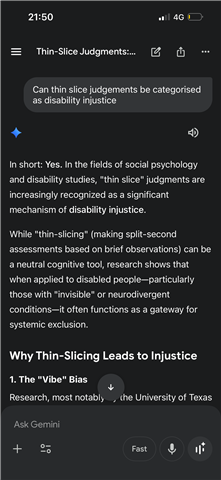
Disability Injustice or Thin Slice Judgements ?

I am looking back at different individual events across my career. At times I still feel that the workplace is one giant systematic nepotistic pile. I would now categorise a lot of these negative experiences as disability injustice in one form or another.

Someone highlighted what I might be experiencing might actually be related to thin slice judgements being made, because of my autism. Certainly some of this applies, but the definitions of disability injustice seem to fall exactly in line with how I viewed those situations. 

 I just wondered whether anyone else had experienced something similar? 

The definitions for anyone who may not be aware: 

Disability injustice 
involves systemic discrimination, ableism, and inequality, where disabled people face unfair treatment, exclusion, and barriers to rights in employment, services, and daily life. Protected by the Equality Act 2010, this includes direct/indirect discrimination, harassment, and failure to provide "reasonable adjustments". 
Key aspects of disability injustice include:
  • Employment Barriers: Being overlooked for jobs, fired due to absences, or denied adjustments to perform tasks.
  • Systemic Discrimination: Inaccessible public services, transport, and environments that exclude disabled people.
  • Forms of Injustice:
    • Direct: Treating a person less favorably because of their impairment.
    • Indirect: Rules or policies that disadvantage disabled people.
    • Harassment/Victimisation: Intimidation or unfair treatment for complaining about discrimination.
  • Legal Protections (UK): The Equality Act 2010 protects against these, and organizations like Inclusion London and Disability Rights UK work to fight for rights.
  • Intersectionality: Discrimination often intersects with factors like sex, race, age, or sexual orientation. 
Thin slice judgments
are rapid, often unconscious evaluations of people or situations based on minimal, short-duration information, usually under five minutes (often seconds) of behavior, facial expressions, or posture. Developed as a psychological concept, these quick impressions can surprisingly predict outcomes, such as personality traits or teacher effectiveness, as accurately as longer observations. 
Key Aspects of Thin Slice Judgments
    • Basis: They rely on nonverbal cues like clothing, body language, posture, and facial expressions.
    • Accuracy: Research by Ambady and Rosenthal (1992) suggests these brief snapshots can be surprisingly accurate in predicting interpersonal consequences, such as teacher effectiveness or salesperson competence
      .
  • Clinical/Social Utility: These judgments are used to gauge personality traits, emotional states (anxiety, depression), and social characteristics.
  • Bias and Limitations: While sometimes accurate, thin slices can lead to negative, long-lasting, and unfair stereotypes, particularly against autistic individuals, who may be judged harshly within seconds of a first impression. 
Contextual Applications
  • Autism: Neurotypical observers often form negative, instantaneous, and inaccurate perceptions of autistic individuals, leading to social devaluation and decreased willingness to interact.
  • Clinical Settings: Clinicians can accurately identify personality disorders or patient emotions from very brief video clips.
  • Social Life: People quickly assess trustworthiness, social status, and competence in strangers. 
In essence, while thin-slicing is an effective, natural, and efficient mechanism for navigating social life, it is heavily susceptible to prejudice and inaccurate, snap-judgment biases. 
  • It does seem close to the core of all human problems with each other. I think it is a huge topic that could open many divisions 

  • Thanks for prompting the discussion  

    Yes I also have come across the concept of negative thin slice judgments in the context of neurotypical perception of autistic people.

    As I understand it this is what may lie behind the autistic drive to "mask".

    As is my habit now I have looked to explore this further with AI and would like to share some findings if that is OK?

    Interestingly, research from DeBrabander et al. (2019) shows that autistic people are also sensitive to "atypical" social signifiers. They may still notice that a peer is "awkward," but they do not let this observation decrease their social interest.

    Research indicates that while autistic people may not naturally produce the same judgmental thin slices of others, we are often acutely aware of and sensitive to the negative judgements neurotypical people make about us. 

    This I believe is problematic.

    AI gives this table to summate why masking is harmful to autistic people

    Summary Table of Harms
    Category Primary Impact Evidence-Based Result
    Psychological Constant performance High anxiety, depression, and suicidality.
    Physiological Chronic stress response Autistic Burnout and physical exhaustion.
    Social Surface-level acceptance Thwarted belongingness; no true connection.
    Systemic Passing as "neurotypical" Delayed diagnosis and lack of support.

    I learned something new in this context - of something called:

    The "Thwarted Belongingness" Paradox
    As even when masking works to bypass a negative thin-slice judgement, it rarely leads to true connection:
    • Surface Acceptance: The autistic person knows the NT peer likes the mask, not the person.
    • Loneliness: This creates a deep sense of "thwarted belongingness"—the feeling of being in a room full of people but being completely unknown.

    naturally one is then drawn to consider if there is are evidence based solutions to this

    An brief version of what the AI comes up with is this:

    Summary of Solutions
    Strategy  Focus Area Impact on Paradox
    Peer Support Identity & Community Provides a safe space to be authentic and find true connection.
    Neuro-Affirming Therapy Self-Advocacy Reduces the drive to mask by valuing the authentic self.
    NT Education Environment & Peers Lowers the "barrier of judgement" that forces masking in the first place.

    "food for thought" and perhaps action maybe? 

    This has made me think about a spin-off thread on the topic of "evolving" authenticity as an autistic person that I would like to explore further.   In order not to complicate this excellent thread I will start a parallel one.

    Thanks

  • DIsabillity Injustice makes for a fantastic summary of NT behaviors though

  • Most employers are naturally inclined to thin slicing. That is my experience but I wasn’t aware I was autistic during my employment years so it wasn’t something I considered, it was just something that happened. If I was applying for a job or was working now, I would be more aware of it happening because I was treated badly by some employers.

    I found this  case which involves ‘salami slicing’. It’s not directly relevant to your experience but I thought the discussion around thin/salami slicing was interesting.

    https://www.3pb.co.uk/content/uploads/A-whole-hog-approach-to-the-burden-of-proof-The-dangers-of-%E2%80%98salami-slicing-a-judgment-by-Grace-Holden.pdf