


I found this YouTube clip while being unable to sleep!
https://m.youtube.com/watch?feature=youtu.be&v=A1AUdaH-EPM
What does everyone think of what she has to say?
I found this YouTube clip while being unable to sleep!
https://m.youtube.com/watch?feature=youtu.be&v=A1AUdaH-EPM
What does everyone think of what she has to say?

Good point well made!
That's very thought provoking.
Why no outcry? (Apart from within the autistic community). Because everything the majority of the general public (and many in the autism industry) knows about autism is wrong.
This is what I've been trying to refer to when I say that perhaps my perception that there are (some? any?) objective medical deficits associated with autism that even a perfect society couldn't alleviate, comes from my own internalisation of those incorrect societal memes / opinions / beliefs.
And I think that your analogy holds true, in that (& I don't think this is controversial?) both autism and sexual orientation are indivisibly bound into the way that a person perceives the world and reacts to it - part of the person in other words.
Thank you for sharing that analogy........more pondering to come I think! :-)
There is another way of illuminating how the deficit model - and the pernicious influences of the discourse this model generates - is not only wrong, but also harmful.
We can do this by (rhetorically?) allocating autism minority status, and comparing society’s, the medical profession’s, and (some) voluntary sector’s attitudes and practices towards it, with those of another minority group.
As an example I will use the LGBTQIA minority group. As its long acronym suggests, it is a heterogeneous group, and it suffers prejudice, but such prejudice is regularly criticised by the voluntary sector, the media and many in society.
Imagine the outcry if - especially in the run up to an election - if a politician was to advocate gay conversion therapy. It would not only be the gay community who’d object, the vast majority of society and the medical profession would be outraged and critical, as would the voluntary sector. Now consider ABA and PBS. It is similar to conversion therapy and has the ethics of a totalitarian regime’s re-education camp. It is also openly advocated on some UK autism sites. Here and here. Why no outcry? (Apart from within the autistic community). Because everything the majority of the general public (and many in the autism industry) knows about autism is wrong.
Now consider giving a bleach solution to young children who adopt a different gender identity to the one they were assigned. This would obviously cause outrage. It happens to some autistic children, sometimes via an enema - essentially child rape - and has been brought to the attention of various authorities and social media platforms for over 5 years. It continues.
The obvious disparity between public perception of autism as an ‘outgroup’, and other minorities, is telling. I recognise that everything is not perfect for other groups, but it seems to me that autism, particularly for those unable to express their objections, is suffering from the narrative provided by the medical model of a triad of impairments, which excludes the social model because the social model is qualitative rather quantitative.
A proper balance between qualitative research and quantitative research would go some way to address this problem. The present imbalance creates a vacuum where fools and charlatans can rush in.

Unfortunately, people in general do mostly (but not exclusively) seem to have a predisposition to align themselves with a 'tribe' where similarities between members are amplified and differences to non-members are also amplified. I guess it is seated in a deep rooted desire to spend time with people who we perceive as being similar to ourselves, people that understand us, maybe?
I don't have a twitter account but if I can access the posts without having a twitter account then it might be worth a shot ,thank you for the tip off!
Thank You for adding another link to ancient autism. That's a very good but very long read so it might be a while before I can formulate a sensible response to it.
I started a thread a while back with some good links to the ancient history of Autism and yes, it would appear that being Autistic was both respected and an advantage
The talk made me want to further studies in Autism! I actually did my first degree in Psychology but studied surprisingly little about Autism apart from just touching on the basics in the development of language and the development of theory of mind. Ironically, when I was heavily pregnant with my youngest I signed up for an Autism Awareness Diploma (luckily with no fixed time frame in which to finish!), to increase my awareness of Autism for my voluntary work in Scouting, but once I had litlun I did not have and still have not had the time to do said diploma! I really must try to find the time to complete that course!
I 'get' the analogy of the long necked giraffe!
Just imagine? Autistic Mars! Our very own Autistic planet!
Just catching up on reading now that the youngest is in bed and the older two have gone out to a fireworks display!
This part of the conclusion to the study is good
"The analytic of epistemic communities can be useful to theorise and account for multiple perspectives and experiences rather than assuming that autism (or any other identity or experiential category) is a singular category or experience."
With regards to any condition it is important not to lose sight of people's humanity. We are more than just a label. Just because someone fits neatly into a diagnostic category does not mean that they become a deindividuated clone of that condition. Everyone, with or without neurological/other condition has different experiences/opinions/etc and it is incredibly important to never lose sight of this.
This bit is also good:
"Examine the impacts of state provision and the economics of support/welfare. A comparative approach enables critical autism studies to examine the ways in which dominant neuro-biological constructions of autism (that span our cultural contexts and are evident in others internationally) take on different forms within different care systems and hence shape provision. Depending upon the definition and the pathology model in use, different treatments are provided (Block & Cavalcante, 2014, Cavalcante, 2003). For example, in Sweden the support offered is guided by the “normalization principle” in which it is stressed that “everyone is of equal value and has equal rights” (National Board of Health and Welfare [NBHW], 2009) at the same time as what is normal and what is included in a normal life is defined from a non-autistic perspective. These principles guide policies and programmes in the field of autism, such as support for finding employment in which being an adult citizen is intimately linked to engagement in work. This might be beneficial for some, but it narrowly constructs productivity and citizenship in neoliberal terms of one’s contribution to the work force. For example, the challenge in Sweden is how to reconcile an approach to welfare state support for people with autism that is guided by a care ethic stressing the rights of disabled people to meaningful employment and participation in society, with an increasingly neoliberal approach that measure one’s productivity in terms of labour force participation, stressing the obligation for all citizens to participate in society through work (Nouf et al, manus). It is clear that governments and financial 19 constraints are significantly affecting the level of support offered for those who need it. In Canada, for instance, where citizens enjoy universal health insurance, recent legal cases have tested the requirement to provide care for children on the autism spectrum (Orsini, 2009; Orsini and Smith, 2010). In the UK changes to the ‘welfare’ system has eroded significantly support and provision for disabled people including those with autism."
It is important that the social model is more accepted by the government and health service so that the autism services provided act to support the autistic person to reach their full potential and effectively manage their symptoms rather than trying to fix them. It is absolutely imperative that 'everyone is of equal value and has equal rights'! There should never be undervaluing of any person due to them suffering from any condition and everyone should have equal rights, even those who have impairment to their mental capacity in one area or another should still be supported to make decisions for themselves as much as is possible and within the parameters set out in the MCA and DOLS. Anyone should have choice as to what constitutes a normal life for them.
All Quotes taken from
O'Dell, Lindsay; Bertilsdotter Rosqvist, Hanna; Ortega, Francisco; Brownlow, Charlotte and Orsini, Michael (2016). Critical autism studies: exploring epistemic dialogues and intersections, challenging dominant understandings of autism. Disability & Society, 31(2) pp. 166–179. |

Shame the same doesn't apply to making killer spreadsheet models
My partner will tell you that it worked for him. 
That would be interesting, a society comprised wholey of people on the spectrum! I'd like to think that we'd all tolerate each others neurodiversity and find roles within in that society that were suitable for all members.
I have realised during the course of this thread that I need to educate myself more as to what exactly the social model of disability encompasses, although @Sam translates it well, thank you! I have included some pretty pictures to explain the social model for the benefit of myself and others:
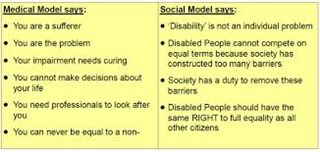
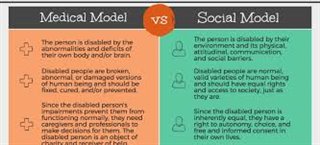
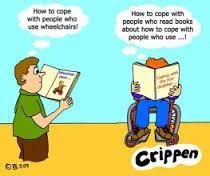
And a piece of research:
How is your daughter doing? How do you find the support that is available for her?
As mentioned elsewhere in this thread, my youngest daughter also has ASD, she will be 3 in February but is still pre-verbal and has many sensory issues. She has and has had a lot of support from a lot of healthcare professionals (she also has global developmental delay and we're awaiting genetic testing to see what other 'hidden gems' show up!). While I fully support interventions that enable an individual to develop to the best of their ability, I absolutely do not support trying to 'fix' autism or any other difference of thinking.
There definitely needs to be much much more work done to remove the barriers to inclusion in society!
Yes I did wonder about that :-). Shame the same doesn't apply to making killer spreadsheet models :-)
I don't know how that would lead to the genes responsible being preserved though
I dunno, being the one who senses the enemy coming that ultimately prevents the tribe from total annihilation is possibly quite the aphrodisiac.
My daughter has Downs syndrome. More money is spent on "early detection" than treatments OR breaking down barriers. :-(
There is a really good quote that sums up the social model brilliantly. But I cant find it so I am going to paraphrase.
This is Fred. Fred has (insert condition here) and is disabled. Once the barriers to inclusion in scociety have been removed they will still have (condition) but they will no longer be disabled.
You are right scociety should be working to remove barriers but instead they are trying to FIX conditions. Why, probably cos it is cheaper and easier and someone can profit from it.

